About

I build one voice system at a time. On purpose.

My name is Fabio Sarcona. I'm the founder of NeedAgent AI, and the person who personally designs, builds, and runs every voice revenue system we put live for home service contractors in the US and Canada. HVAC, plumbing, electrical. Three verticals. By choice.

There are software companies that will sign you up tomorrow, send you a login by email, and call it a day. That's not what this is. What you're about to read is the long version of why.

Fabio Sarcona
Fabio Sarcona
Founder & System Architect, NeedAgent AI

The Story

How I ended up building a voice system for North American home service contractors from Sicily.

The honest answer starts in a place that has nothing to do with the trades.

For nine years before NeedAgent AI existed, I designed digital products for a living. UX, front-end development, the whole stack of things that make a piece of software feel like a tool people actually want to use instead of one they tolerate. I worked across four continents, across industries I had no business being an expert in when I started. Fintech, healthcare, e-commerce, a few in between. The job, simplified, was always the same: figure out where the workflow breaks for the human, then close the gap.

I noticed something doing that work for almost a decade. Most operational problems are not technology problems. The tools almost always exist. What's missing is someone willing to sit down with one specific business, understand how it actually runs, and configure the tools so they do the job. Not in a demo. In production. On a Tuesday afternoon when three things are on fire at once.

The companies I worked for could afford to hire someone like me to do that work. I started wondering who was doing it for the businesses that couldn't.

That question is what eventually led me to a thread on a contractor forum. An owner-operator venting about the same week he'd had every summer for fifteen years. Phones ringing off the hook, his front office overwhelmed, calls going to voicemail after 6 PM, and several thousand-dollar replacement quotes sitting in his inbox that he hadn't gotten back to. He wasn't asking for software. He was asking if anyone else had figured out how to not lose forty grand to the same problem every year. The comments underneath were what hooked me. Plumbing contractors describing the exact same pattern around 2 AM burst-pipe calls. Electrical contractors talking about panel upgrade and generator quotes going cold because nobody had time to follow up on a Wednesday morning. HVAC owners trading notes on heatwave weeks with two techs out and an inbox full of unanswered missed calls. Every one of them solving the problem the same way. Improvised.

I spent the next several months doing what UX people do when they get curious. ServiceTitan and Jobber and HousecallPro community threads. ACCA reports. NATE certification material. The Mike Holt forums on the electrical side. Plumbing threads going back ten years. Bloomberg pieces on the trades labor shortage. Then I stopped reading and started asking. I got on calls with HVAC owners in Texas, plumbing operators in the Midwest, electrical contractors on the East Coast. Three to ten trucks. Owner-operated. Already running an FSM platform. One question for every call: what I'm seeing in the data, is that what you're actually living every week?

The answer was the same every time, regardless of trade. It wasn't a marketing problem. They were already running Google Ads. They had decent websites. The leads were arriving. The problem was what happened to the leads after they arrived, and specifically, what didn't. A 9 PM call about a dead AC unit going to voicemail. A 2 AM burst-pipe emergency missed because the on-call rotation was overloaded. A $9,500 HVAC replacement quote sent on a Friday and never followed up. A $7,500 repipe estimate going cold after eleven days. A $3,000 panel upgrade quote. Same story.

That's the problem I built NeedAgent AI to fix. Not the tools. The execution.

Why Different

The difference between a tailor and a factory.

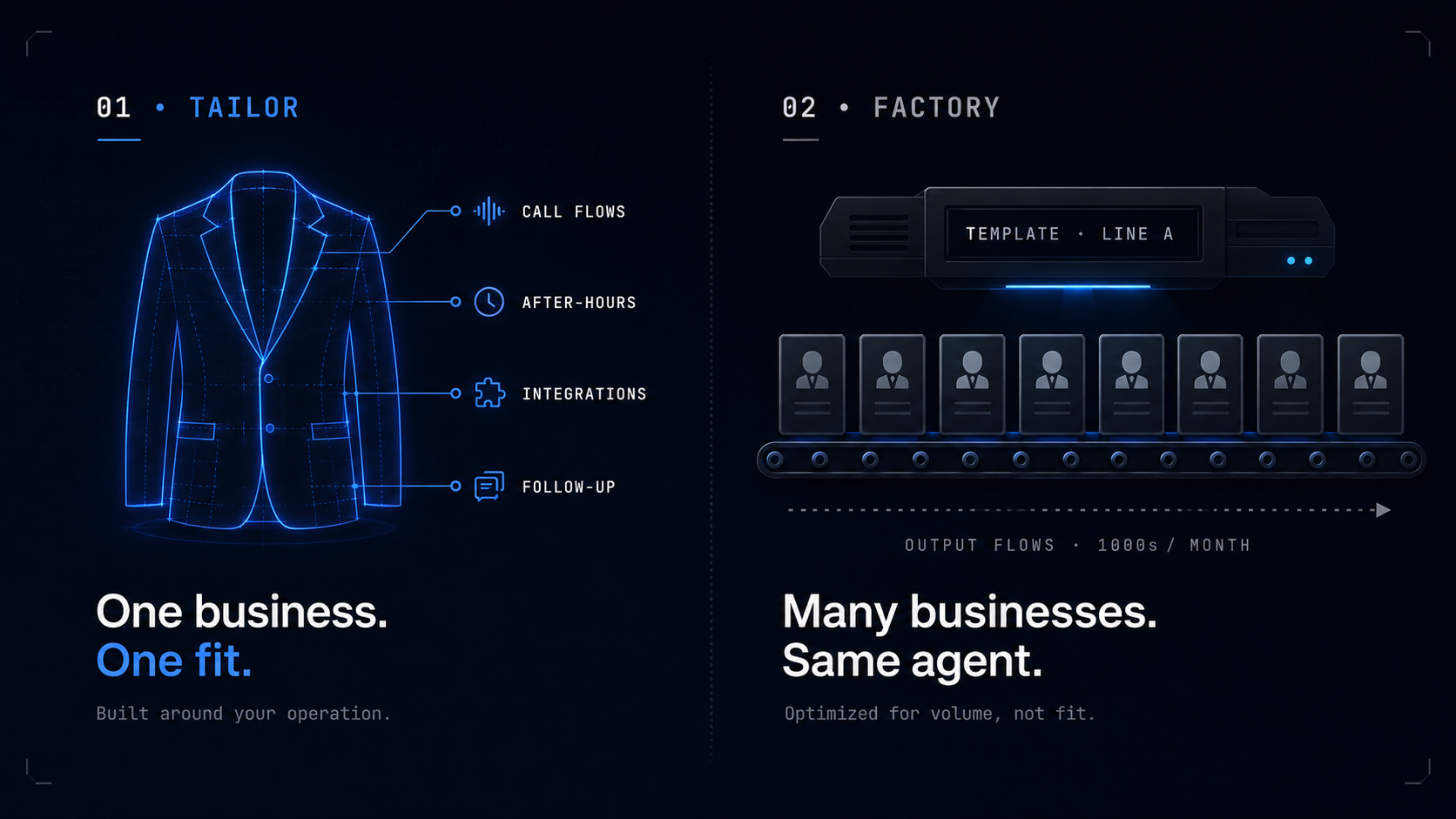
Tailor versus factory. On the left, a wireframe blueprint of a tailored suit jacket with four callouts (call flows, after-hours, integrations, follow-up) labeled 'One business. One fit.' On the right, an industrial machine on a conveyor belt producing identical contractor cards labeled 'Many businesses. Same agent.'

The voice AI category is filling up fast. Some of the companies in it are very well funded, very well marketed, and very, very good at growth. They have demo videos that look beautiful. They have "AI agent" templates you can spin up in a free trial. If you're a home service contractor with an inbox, you already know who they are, because they've all emailed you.

I have nothing bad to say about most of them. The technology is real. The infrastructure works. But I want to tell you what I see when I look at how they sell, because it's the exact reason NeedAgent AI exists.

Their business model is a factory. The factory's job is to produce voice agents at scale, the same agent, fundamentally, dressed up in slightly different clothing for the dentist, the chiropractor, the plumber, the realtor, the HVAC contractor, the electrician. The factory needs to add thousands of customers a year for the math to work. Every customer you sign is a row in the CRM, a number in the MRR chart, a checkbox on a quarterly OKR. The moment you're signed, the factory's incentive, by design, not by malice, is to move on to the next sale. Your call flows are your job. Your integration is your job. The reason it's not converting on Thursdays is also your job, and the support article will help you figure it out.

That model works for some categories. It does not work for home service operations doing $150K a month with a small back office that doesn't have time to configure another platform.

I built NeedAgent AI on the opposite premise. I'm not a factory. I'm a tailor.

A tailor takes your measurements before cutting anything. He asks you what you'll be wearing the suit for. He notices that one of your shoulders sits half an inch lower than the other and adjusts for it without telling you, because that's the job. He hands you the suit when it actually fits, not when the production schedule says it's done. And if something feels off after you've worn it for a few weeks, he asks you to come back in so he can fix it.

That is the model. That is the entire model.

When you engage with NeedAgent AI, you are not becoming a row in a CRM. You're becoming one of three operations I'm focused on this month. The Audit is the measurement. The build is the cut. The 60-Day Performance Safeguard is the "come back in so I can fix it." When the system is live, I'm the one listening to real calls, watching where the conversation slows down or breaks, and adjusting. Not a customer success rep with a quota. Not a support ticket queue. Me.

That posture matters because it changes what you're actually buying. You're not buying access to a tool, you're bringing in an external operator who runs the parts of your business your team can't physically cover, with the explicit job of making your top-line revenue go up as a measurable result. Your revenue going up is the only thing that justifies the engagement continuing. If the numbers stop making sense, we should both know that fast, and we should both have the integrity to act on it.

That's why I cap at three new clients a month.

Clarity

One thing I should be upfront about.

I'm not a former HVAC owner, a master plumber, or a licensed electrician. I've never installed a condenser, run a repipe, or pulled a panel permit. The first conversation I had with a master plumber, I had to ask what a backflow preventer was. I had no business pretending otherwise then, and I won't pretend otherwise now. What I bring to the relationship is not trade expertise, it's nine years of doing the work of figuring out where workflows break and engineering systems that close the gap. Your trade expertise stays where it belongs: with you and your techs.

The Method

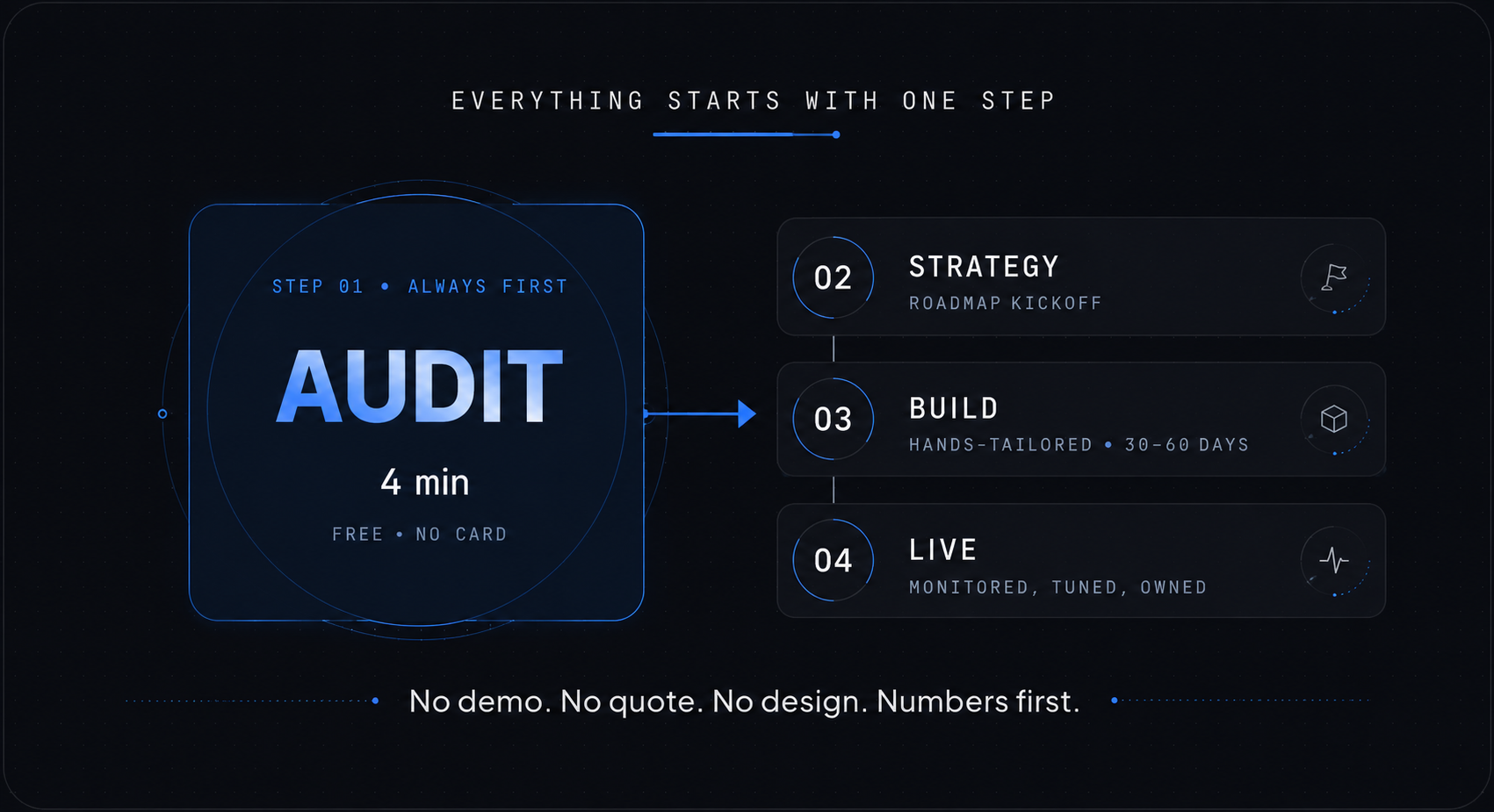
The Audit comes first. Always. No exceptions.

Audit-first method. A luminous module labeled 'Audit. Step 01. Always first. 4 minutes. Free, no card.' connects to three stacked cards: 02 Strategy (roadmap kickoff), 03 Build (hands-tailored, 30 to 60 days), 04 Live (monitored, tuned, owned). Caption reads 'No demo. No quote. No design. Numbers first.'

Most vendors in this space lead with a demo. The demo is impressive. It's supposed to be. That's the demo's entire job. What the demo doesn't tell you is whether the system is going to recover meaningful revenue for your specific operation. Whether your version of the leak is in after-hours emergencies, or unfollowed quotes, or no-show appointments, or dormant customers, and whether the math even works for the way your specific business runs.

I reversed that order on purpose. Before I quote you anything, before I design anything, before we talk about pricing or contracts or timelines, you run the Audit. It takes four minutes. It costs nothing. It gives you a report. Written for your operation, calculated from your inputs, scoped to your trade. That quantifies where revenue is leaking and how much. You keep the report whether you hire me or not. If it shows you're not losing enough to justify the engagement, I'll be the first one to tell you.

The Audit is also, candidly, my answer to the "do you have case studies?" question. NeedAgent AI is in early rollout. I haven't fabricated testimonials and I haven't padded the page with stock photos of fake executives saying nice things about a system they never used. What I have instead is your numbers. Calculated from your operation, not someone else's. That's a better case study than anything I could write, because it's yours.

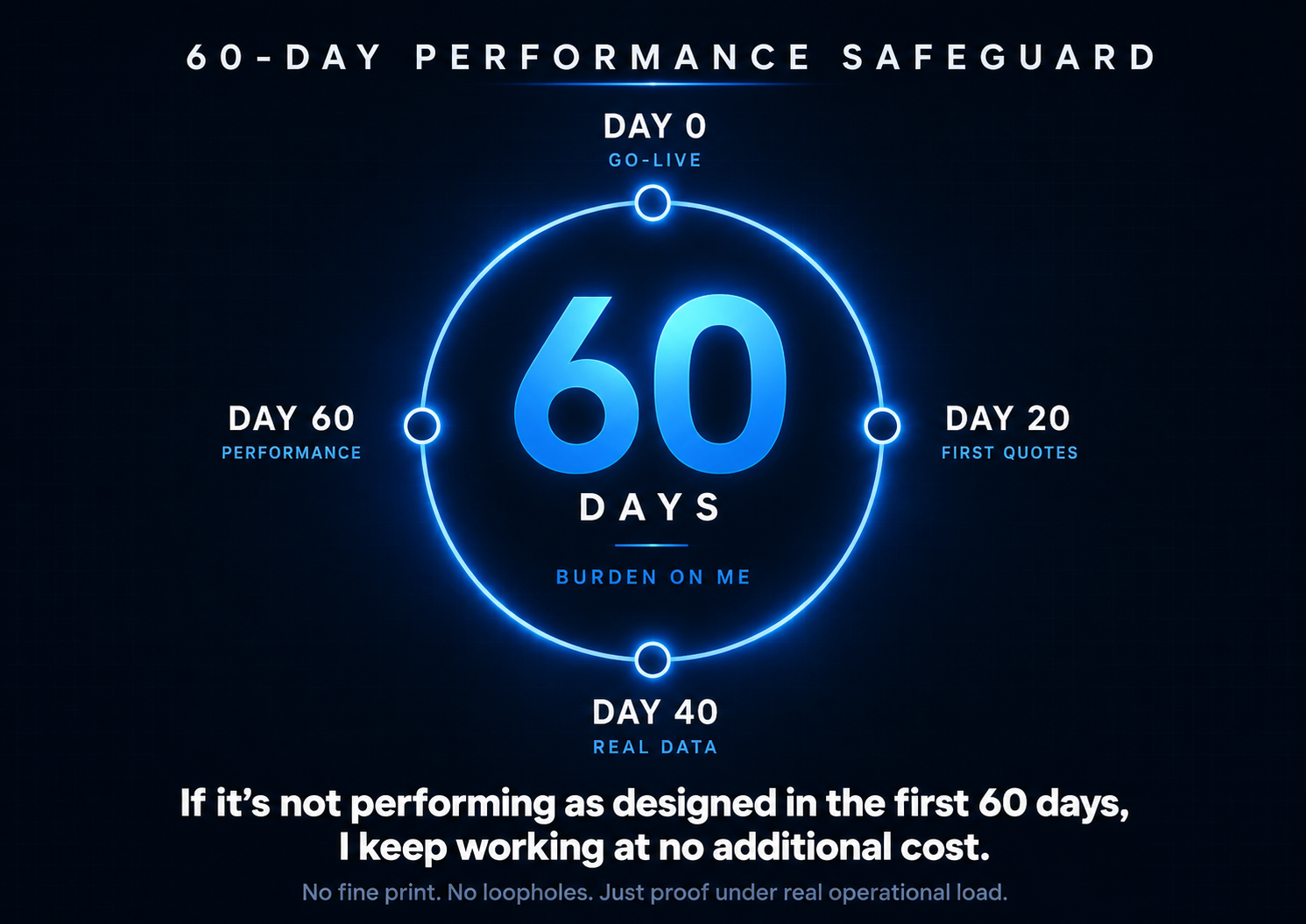
60-Day Performance Safeguard. A large luminous dial showing 60 days at the center with four cardinal checkpoints. Day 0 (go-live), Day 20 (first quotes), Day 40 (real data), Day 60 (performance). Caption: 'If it's not performing as designed in the first 60 days, I keep working at no additional cost. No fine print. No loopholes. Just proof under real operational load.'

And once we've moved past the Audit and the system is live, the 60-Day Performance Safeguard completes the model. If, within the first 60 days after go-live, the system isn't performing as designed for your operation, I keep working on it at no additional cost until it does. No fine print, no "subject to" clauses. Sixty days is the window because it's the rhythm at which a contractor business actually generates evidence: enough quote cycles, enough service calls, enough after-hours emergencies for the system to have been tested under real operational load. That's when the proof shows up, and that's when the burden should be on me to make sure it does.

Where I Operate From

Based in Sicily. Built for North America.

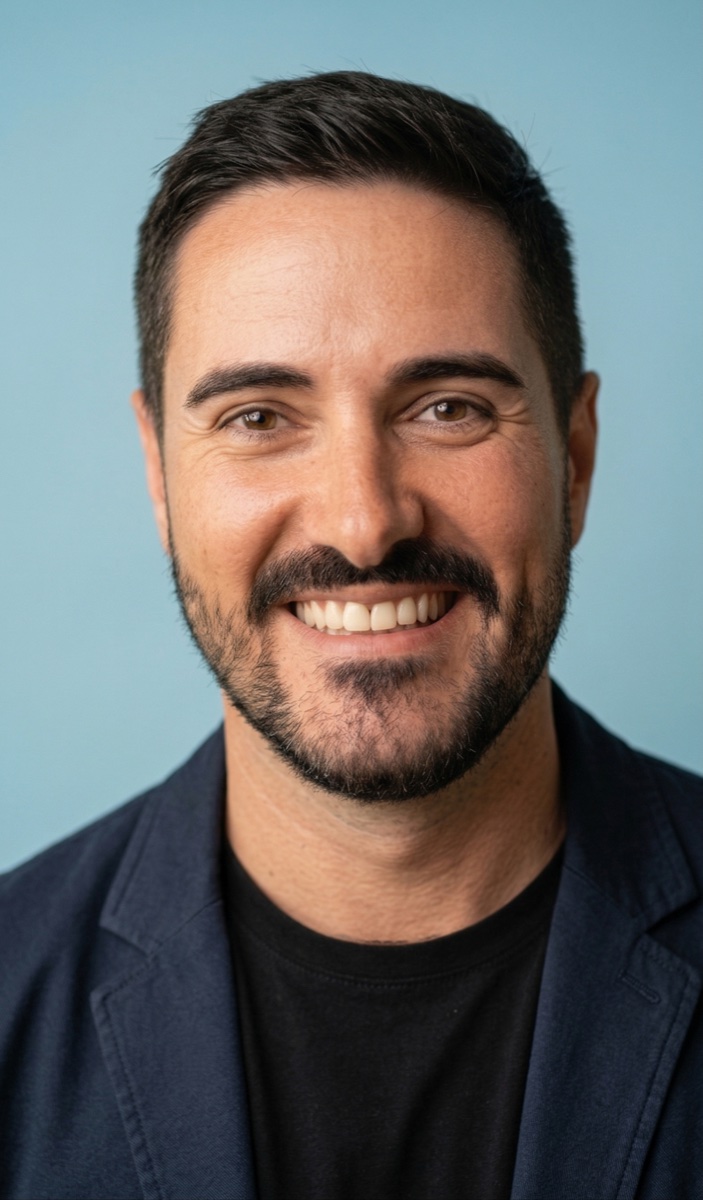
Fabio Sarcona, founder and system architect of NeedAgent AI, photographed in editorial portrait.
Fabio Sarcona — System Architect & Founder, needagent.ai

I get this question on almost every first call. You're based in Italy. Why are you building voice AI for home service contractors in North America?

The technology layer doesn't care where I sit. The voice infrastructure runs on US-hosted Twilio. The conversational AI runs on Retell. Your FSM software. ServiceTitan, Jobber, HousecallPro. Stays where it is. Everything that touches your customers runs in US infrastructure, hitting North American phone numbers, in compliance with TCPA and FCC rules.

What matters is who's running it. The answer is me. Directly. Every setup. Every call I listen to during the monitoring phase. Every adjustment I push when the data tells me something needs to change. Coming to this market from outside the trades is actually the thing that made the system possible in the first place. Insiders stop noticing the problems they live with every day. Spending fifteen summers losing forty thousand dollars to missed calls makes the loss feel like the weather, something you deal with, not something you fix. Coming from outside, I could see the pattern without the resignation. That outsider angle is a feature, not a bug.

The Principles

The three things I won't change, no matter what.

Vertical focus stays narrow.

HVAC, plumbing, electrical. That's it. Not because I couldn't technically configure the system for other trades, but because the depth of configuration that makes the work work doesn't transfer. A call flow built for a 2 AM burst pipe is not the same as one for a panel upgrade quote follow-up, and neither is the same as an after-hours no-AC emergency. I'd rather be excellent in three verticals than mediocre in twelve.

Done-for-you means done. By me.

There is no version of this where you log in to configure your own call flows on a Tuesday night. If you want a tool, the tool category has dozens of options. NeedAgent AI is the service that operates the tools, and I'm the one operating them.

Honest disqualification beats oversold engagement.

The cheapest mistake I can make is taking on the wrong client. So if your operation isn't the right fit. Wrong size, wrong vertical, wrong stage of growth, I'll say so on the first call, refund nothing because you'll have paid nothing, and we'll both move on with our day. That posture is non-negotiable. It's the only way the model holds up over time.

The Next Step

If you've read this far.

If you're a home service contractor running a three-to-ten-truck operation. HVAC, plumbing, or electrical, and something on this page resonated with how you want to be worked with, the next step is the Audit.

Four minutes. No credit card. No sales call attached. You'll get a report written for your operation that quantifies where your revenue is leaking and how much. The report is yours to keep. What you decide to do after you read it is entirely up to you.

Pick your vertical below.

4 minutes. No credit card. No commitment. The report is yours either way.

Not ready for the Audit yet? That's fine. The Audit isn't a contract. If you'd rather start with a conversation, or you have a question I haven't answered on this page. Email me directly. I read every email myself, and I respond within one business day.

fabio@needagent.ai
"Most vendors scale by adding clients. I scale by making sure each one works before adding the next. That's not a marketing slogan, it's the only way the work stays good."
Fabio Sarcona, Founder & System Architect, NeedAgent AI