
A contractor in a Facebook group I follow posted this last month:
"Honestly feels like half the calls right now are just people trying to get the cheapest fix possible. Hard to move installs when everyone's shopping price."
The thread had 21 comments. Almost all of them argued about pricing. Hold your price. Sell value. Walk away from the cheap ones. Train the CSR to handle objections.
Every reply treated price shopping as a sales problem. None of them looked at where the call actually lands before anyone says a number. That blind spot is the whole story. The customer who "shops price" usually isn't shopping price at all. They're shopping for whoever picks up.
Why do HVAC customers shop price?
Most HVAC price shopping isn't about price. The typical homeowner with a dead system calls three to four contractors in a row (Gartner puts the average buyer at 3.5 vendors). They aren't comparing quotes line by line. They're calling down a list until someone answers, sounds competent, and can show up.
Picture the sequence from the homeowner's side. The AC quits on a 95-degree afternoon. They pull up the first three results, and they start dialing. The first contractor's line goes to voicemail. The second one answers, takes the address, and books a visit for the next morning. The third one answers too, but now the homeowner already has an appointment, so the conversation shifts. The only thing left to talk about is price.
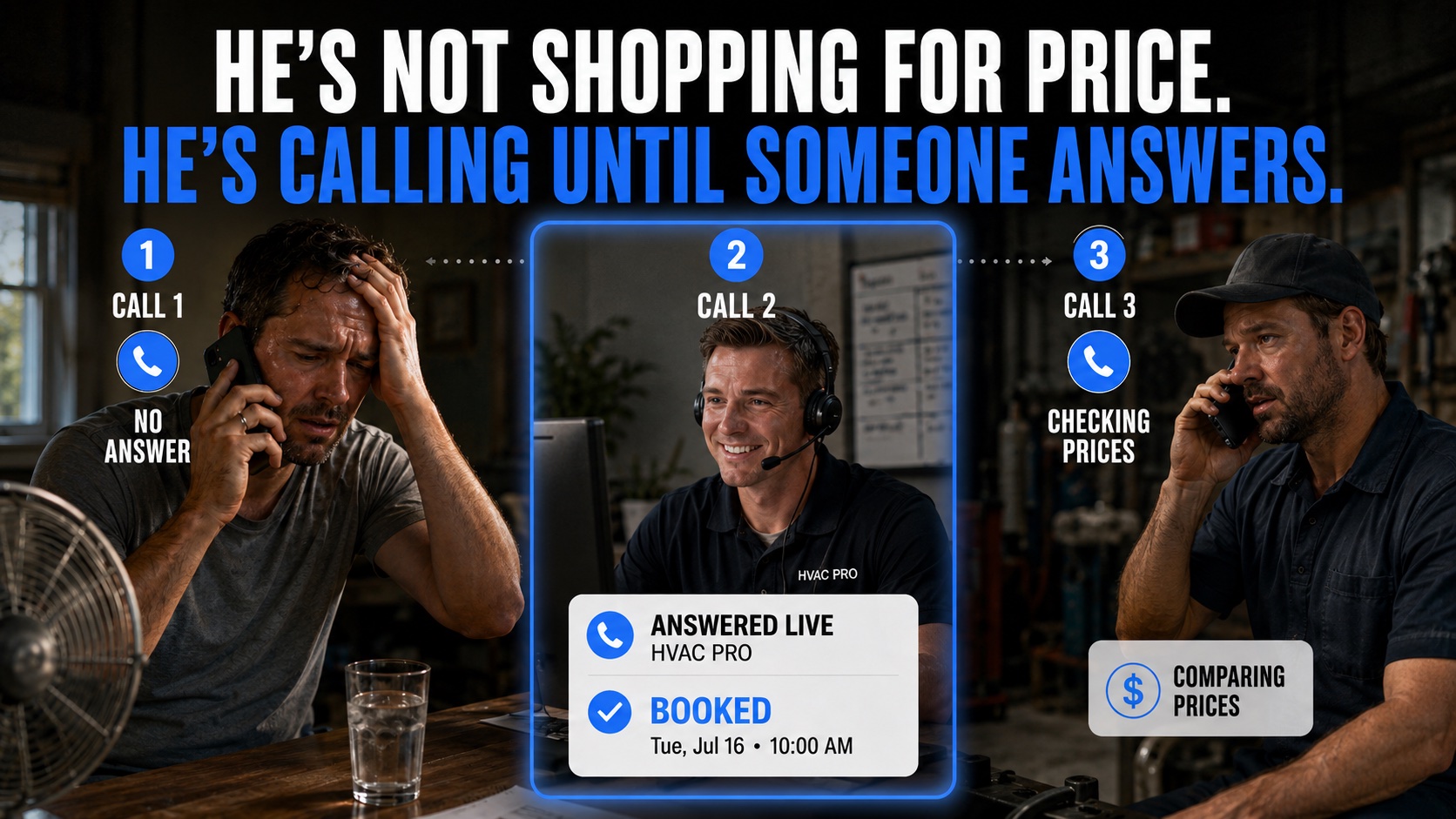
By the time someone reaches the third or fourth contractor, the job is half-decided. That last contractor walks into a conversation that's already been framed by whoever answered first. The number is the only lever left, so the homeowner pulls it. From the contractor's chair, it looks like "everybody's just price shopping." From the homeowner's chair, they were ready to book ninety minutes ago.
The average buyer contacts 3.5 vendors. The first one to answer doesn't compete on price. The last one has nothing else to compete on.
This matters because the contractors most convinced that the market is a price race are often the ones losing the speed race without seeing it. The missed-call problem and the price-shopping complaint are the same problem wearing two different faces. Roughly 27% of inbound calls to home service businesses go unanswered (Invoca, 2025). A missed call doesn't show up as a lost sale on the books. It shows up later, as a vague sense that customers care about nothing but price.
What actually decides who wins a price-shopping call?
The first contractor to respond controls the price conversation. Research on lead response shows 78% of customers buy from the company that responds first, often regardless of price or brand (MIT Lead Response Management Study, via Harvard Business Review). Whoever answers first sets the frame. Everyone after that is negotiating against an appointment that already exists.
Most contractors think price shopping is a sales problem, so they fix the sales layer. They write better objection scripts. They coach the CSR on holding the number. They build a tiered presentation so the customer has options. None of that is wrong. It's just downstream of the thing that actually decided the outcome.
The real problem is response time. When you answer first, you're the contractor with the appointment. You set the expectation for what a competent shop sounds like. You frame the diagnosis, the timeline, the reason this isn't a parts-swap on the cheap. The second and third contractors now have to dislodge that frame, and the fastest tool to do it is a lower number. So they cut price, the homeowner learns that price is negotiable in this trade, and the race to the bottom gets one notch worse for everyone.
There's a second-order cost here that the pricing argument completely misses. Every time a contractor competes on price because they were third in the rotation, they reinforce their own belief that the market is saturated and cheap. That belief then shapes how they answer the next call: a little more defensive, a little quicker to discount. The speed problem doesn't just cost the individual job. It slowly rewrites how the contractor sees the entire market.
What changes operationally when you're the first call
Being first isn't about answering faster while you're already buried. It's about making sure every inbound call reaches a competent human or system before it rolls to voicemail, even when the whole crew is on the truck. That's an operations question, not a sales question, and it's where most shops actually leak.
Here's where the calls go missing. The phone rings at 11 a.m. when the owner is under a unit and the one CSR is already on another line. It rings at 4:45 p.m. on a Friday when the office has mentally clocked out. It rings at 8 p.m. when nobody's there at all. Those are exactly the windows when a homeowner with a dead system is dialing down their list of three. Miss that window, and you don't lose to a cheaper competitor. You lose to a faster one, and then you blame price.
Every call gets answered live, including overflow and after-hours
The job isn't to answer the calls you can. It's to answer the ones that currently hit voicemail, because those are the ones your faster competitor is booking.
The first interaction captures and books, not just records a message
A voicemail you return the next morning puts you in fourth place on a list that's already closed. A live answer that books the visit puts you in first.
The address and the appointment come before the price discussion
Once the visit is on the board, the call stops being a quote comparison and becomes a scheduled job. The price conversation happens on your terms, in person, after the diagnosis.
This is the layer that sits underneath every "how do I handle price shoppers" question. A voice intake system built specifically for HVAC dispatch answers the overflow and after-hours calls that decide who's first, and books them before they roll to the next contractor on the list. The objection-handling script still matters. It just matters a lot less when you're the one with the appointment instead of the one trying to talk a homeowner out of the appointment they already made.
If you want to know whether price shopping is really your problem or just the symptom you can see, the place to look isn't your pricing. It's where your calls actually land during the hours your crew is in the field. That's the same blind spot behind the four operational leaks that quietly drain revenue without ever showing up on the P&L.
The Revenue Leakage Audit · 4 minutes
Want to see where your calls are actually landing before you assume the market is a price race? The audit maps your real intake flow: which calls reach a human, which roll to voicemail, and what that's costing you in booked jobs. You keep the report whether we talk or not.
Run the auditFor the full operational picture of where HVAC revenue actually leaks, see the four operational leaks that drain HVAC contractor revenue and the 27% missed-call math behind the same intake gap.